
'Similarly, he is against Dalits forgetting that the only way to get rid of poverty is to empower poor people.'

Shares of rate sensitive sectors such as realty, infrastructure, banking and automobiles ended higher ahead of the Reserve Bank of India (RBI) mid-quarter policy review on June 17.

Internal report, to be finalised in seven-10 days, may also suggest reduction in subsidies
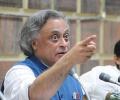
During the Congress regime, India did witnessa slew of reforms which are now taken up by the Modi government too.
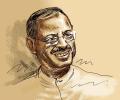
Anil Swarup, who conceived the Rashtriya Swasthya Bima Yojana -- a scheme the United Nations Development Programme and the International Labour Organisation recognised as among the finest -- speaks to Anjuli Bhargava.
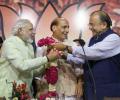
Modi has the ideas for a new, hopeful India, and an idiom in which to sell optimism to voters. But he doesn't yet have the team for it, and soon enough, questions will begin to be asked by an impatient, non-ideological, I-don't-owe-anybody-anything generation of Indian voters, says Shekar Gupta.

Those scheduled to attend the five-day WEF Annual meeting, beginning January 21, include more than 40 heads of state or government, including those from the UK, Australia, Japan, Iran, Israel, Pakistan, Brazil, Italy, Mauritius, Republic of Korea and Switzerland, WEF announced on Wednesday at a press conference in Geneva.
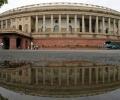
When Prime Minister Narendra Modi recently extended a Rs 8,000-crore (Rs 80 billion) central support for building roads in Jammu & Kashmir, Union Cabinet's approval for the big-ticket announcement came in barely 48 hours.
'Chidambaram, lots of people argue not without justification, is all about bluff and bluster without any concrete achievement on the ground. His record in the finance ministry fully endorses that view,' argues Virendra Kapoor.

The Planning Commission has not been central to the policy making process since the mid-1960s, says Nitin Desai.

I still believe that it is a good thing that think tanks are mushrooming in Delhi. They provide a platform for discussion, even if they shed more heat than light. With Parliament almost incapable of serious debate, informed discussion and civilised discourse, where does this nation get its intellectual churn, asks Mohan Guruswamy.

The target of $500 billion in bilateral trade by 2020 is doable, feels Anand Sharma.

'Karna is the greatest warrior in the Mahabharata -- in fact, Arjuna is a nobody in front of Karna.' 'But Arjuna had a better advisor in Krishna than Karna.' 'Karna failed because he listened to the wrong advice given by Salya.' 'It just shows wrong advisors can land even the mighty in trouble.'

In putting the country's economy back on the rails, it is best that Narendra Modi and Arun Jaitley draw on grass-roots feedback and their own practical sense and native wisdom without allowing themselves to be sucked into the quicksand of economic punditry, says B S Raghavan.

One hopes the higher courts take the extraordinary steps needed to secure justice for the victims. The Gujarat carnage demands nothing less because of its unique nature and sponsorship by the State, argues Praful Bidwai.

Business reacted with caution to the reforms of 1991, and demanded protection from multinationals and imports. Twenty-five years later, traces of that demand can still be found, reports Bhupesh Bhandari.
'The Congress can't return to power unless it reins in prices, lowers interest rates, taxes the rich,' says Praful Bidwai. 'If this means sacking those most responsible for the UPA's pro-big business policies including Finance Minister Chidambaram, so be it!'
